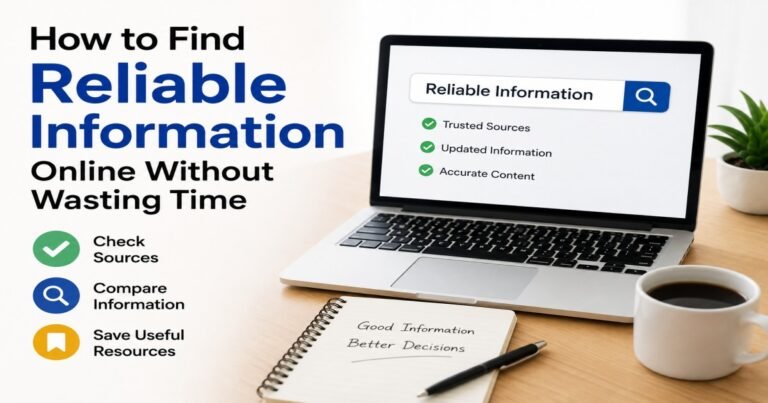
Why Information Accessibility Has Become a Critical Factor in Digital Trust
People increasingly expect information to be available immediately. Whether checking examination results, tracking application statuses, reviewing public records, or accessing service updates, users rarely tolerate unnecessary delays or confusing navigation.
This shift has changed the way digital platforms are evaluated. Speed alone is no longer enough. Users expect information to be accurate, easy to locate, and presented in a format that minimizes effort.
For organizations responsible for serving large audiences, information accessibility has become a strategic advantage rather than a technical feature. The platforms that simplify access often earn higher trust levels, stronger engagement, and better long-term retention.
How Information Structure Influences User Confidence
Accessibility Reduces Decision Friction
When users arrive on a website, they usually have a specific goal. They may want to verify a result, locate a document, confirm eligibility criteria, or review important updates.
Every additional step creates friction.
When navigation is confusing, visitors spend more time searching than accomplishing their original objective. That experience weakens confidence in the platform.
A useful comparison can be found in specialized digital entertainment ecosystems. Users evaluating instant-game platforms often need quick access to game categories, provider information, account features, and available formats. A review of this website shows how instant games are grouped into clearly defined sections, allowing visitors to understand available options without navigating through multiple layers of menus. This approach demonstrates an important principle that extends far beyond gaming environments: well-organized information reduces uncertainty and helps users reach decisions faster.
Predictability Creates Trust
Trust is often associated with security and reliability, but predictability plays an equally important role.
Visitors trust systems that behave consistently. They expect important information to appear in familiar locations. They expect search functions to produce relevant results. They expect updates to follow recognizable formats.
When platforms repeatedly meet these expectations, confidence grows naturally.
Organizations frequently underestimate how much user trust depends on consistency rather than complexity.
Why Fast Access Matters More Than Ever
Users Evaluate Experience Before Content
Many digital strategies focus primarily on the information itself. However, users often evaluate the experience of finding information before assessing the information’s quality.
Consider a student searching for examination results. The result may be accurate and complete, but if finding it requires navigating through multiple confusing pages, the overall experience becomes negative.
The same pattern appears across industries. Visitors judge the effectiveness of a platform partly by how quickly it helps them complete a task.
This means information architecture deserves the same level of attention as content creation.
Digital Expectations Continue To Increase
User expectations are shaped by their best digital experiences elsewhere.
People who regularly use highly optimized platforms expect similar convenience from educational, governmental, informational, and commercial websites. They compare experiences whether organizations realize it or not.
Several expectations have become standard:
- Fast page loading
- Clear navigation paths
- Mobile-friendly access
- Search functionality
- Organized content categories
Platforms that fail to meet these expectations risk losing audience confidence even when their information remains valuable.
What Decision-Makers Can Learn From High-Performing Platforms
Simplicity Often Outperforms Feature Expansion
Organizations frequently add new tools, menus, and content sections in an effort to increase value.
Unfortunately, additional features can create confusion when they are not integrated thoughtfully.
The most effective platforms usually focus on simplifying user journeys rather than expanding complexity. Every feature should support a specific user objective.
When users can achieve goals quickly, satisfaction increases.
When satisfaction increases, trust follows.
Information Hierarchy Determines Usability
Not all information carries equal importance.
Successful platforms prioritize critical information and make it immediately visible. Secondary content remains available but does not distract users from primary objectives.
An effective information hierarchy generally follows this sequence:
- Core user objective
- Supporting information
- Additional resources
- Related content
- Secondary navigation options
This structure helps visitors process information efficiently without feeling overwhelmed.
How Accessibility Supports Long-Term Growth
Better Experiences Improve Retention
Retention is often discussed in the context of subscriptions, memberships, or customer loyalty programs. However, user experience frequently influences retention before any formal relationship develops.
People return to platforms that save time.
They revisit sources that consistently provide reliable information.
They recommend websites that solve problems efficiently.
These behaviors contribute directly to long-term growth because they reduce acquisition costs and increase organic audience development.
Accessibility Strengthens Brand Reputation
Reputation develops through repeated experiences.
Each positive interaction reinforces confidence. Each frustrating experience weakens it.
Organizations sometimes invest heavily in branding campaigns while overlooking usability improvements that would produce stronger long-term effects. In practice, users often judge credibility through direct interactions rather than promotional messaging.
A platform that delivers information efficiently builds trust through performance rather than promises.
Why Information Accessibility Will Become Even More Important
Digital Audiences Expect Self-Service Solutions
Many users prefer solving problems independently rather than contacting support teams.
This preference increases the value of accessible information systems.
Platforms that provide clear guidance, organized resources, and intuitive navigation empower users to find answers without assistance. This improves both user satisfaction and operational efficiency.
The trend toward self-service experiences continues growing across industries.
Trust Is Increasingly Built Through Utility
Trust is no longer based solely on reputation or institutional recognition.
Modern audiences evaluate organizations based on usefulness. They ask practical questions:
Can information be found quickly?
Is it accurate?
Is it easy to understand?
Does the platform respect the user’s time?
Organizations that answer these questions positively create stronger trust than those relying exclusively on brand recognition.
Conclusion
Information accessibility has become one of the most important drivers of digital trust. Users judge platforms not only by the information they provide but also by how efficiently that information can be accessed.
Organizations that simplify navigation, reduce friction, and prioritize user objectives create stronger experiences and stronger reputations. Their success comes from making information useful at the exact moment people need it.
As digital expectations continue rising, accessibility will increasingly separate high-performing platforms from those that struggle to maintain engagement. For decision-makers, investing in information organization and usability is no longer a technical consideration. It is a strategic business decision that directly influences trust, retention, and long-term growth.
Read More Blogs Like This On UpResultNicin. Also Join Whatsapp Group For More Updates.